
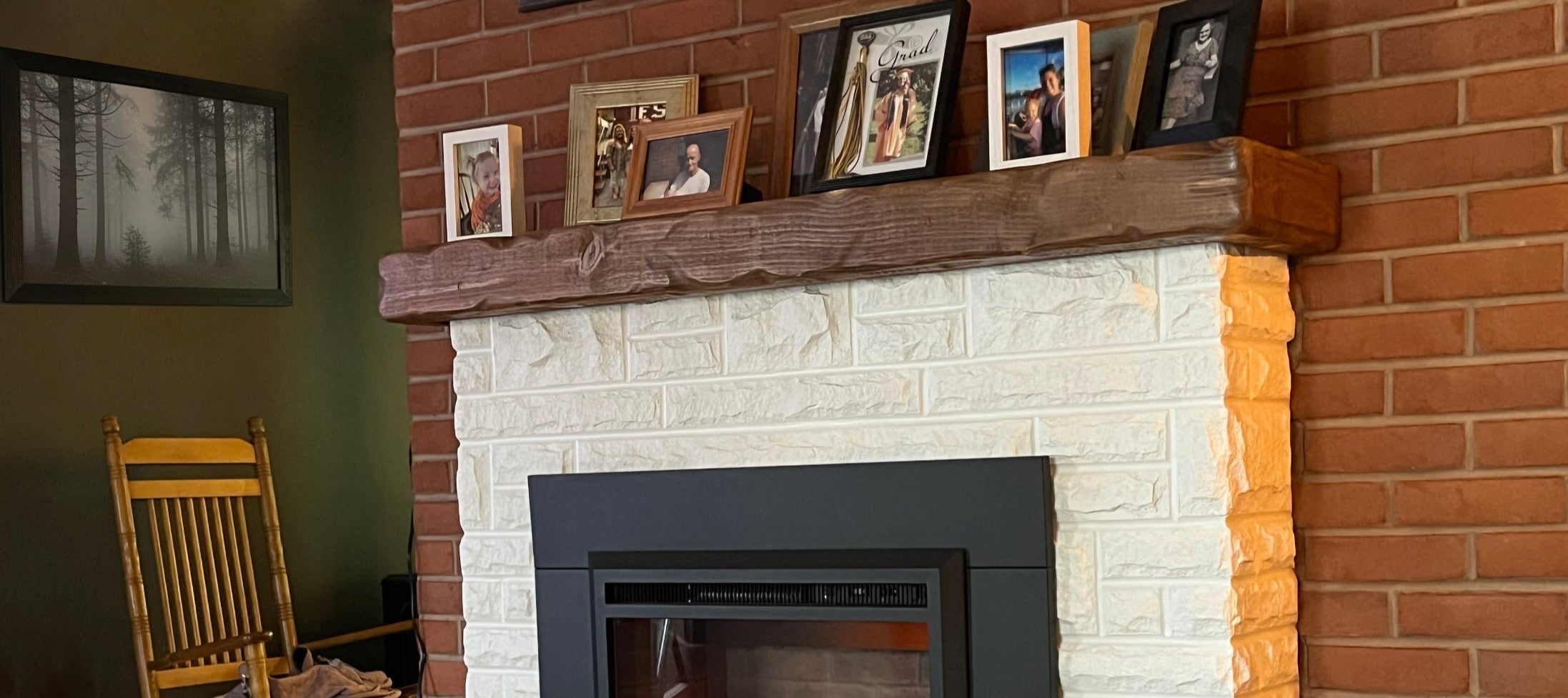
Many fireplaces aren’t perfectly flat or square, especially those built with brick or stone. Older homes, in particular, often have uneven surfaces, stepped masonry, or walls that aren’t perfectly plumb. It’s very common for homeowners to wonder whether a mantel cover can still work in these situations.
The short answer is yes. Mantel covers can be designed with enough tolerance to account for minor variations in the installation area, and installation instructions and appropriate hardware are included for different surface types.
This article explains what we look for, how we account for irregular surfaces, and what helps ensure a clean, secure installation.
It’s also important to note that in many cases, small gaps behind the mantel are completely acceptable and don’t require any additional work. Minor variations in brick, stone, or wall surfaces are common, and when the mantel is properly sized and installed, those gaps are often not noticeable and don’t detract from the finished look.
In fact, leaving small gaps untouched is often the simplest and cleanest solution, and many installations look great without any additional treatment.
This guide covers how mantel covers work with brick, stone, and uneven surfaces. For a complete overview of measuring, installation, and next steps, you can start with our fireplace mantel cover guide
How Mantel Covers Work Over Brick and Stone
A mantel cover is designed to fit over an existing mantel, not rely on the masonry alone for support. That existing mantel provides the primary structure, while the cover is shaped to accommodate what’s behind and beneath it.
When brick or stone is involved, we:
-
Allow for minor variation in depth and flatness
-
Design the cover to sit cleanly against the wall
-
Plan attachment methods based on the surface material. View our attachment guide here.
The goal is for the finished mantel to look intentional, not like it’s fighting the wall behind it.
What Happens If the Brick or Stone Is Uneven?
When surface variations are more noticeable, there are several proven options available to achieve a clean, finished look, but many installations don’t require any additional steps at all.
Caulking (small gaps, under ⅛”)
A small bead of caulk is often enough to fill minor gaps. This is a long-established method used by carpenters to create a seamless transition between materials.
Tip: Using a caulk that closely matches the mantel or masonry helps keep the joint unobtrusive.
Wood Trim (moderate gaps, up to ½”)
On surfaces such as drywall where gaps are more consistent, decorative wood trim painted to match the wall can create a clean, intentional finish.
Scribing and Cutting (larger or irregular gaps)
For fireplaces with more pronounced variation—such as rough stone—the back of the cover can be scribed and adjusted for a closer fit. This is a common carpentry technique used to achieve a flush appearance on uneven surfaces.
Tiered, Stepped, or Decorative Masonry
Some fireplaces have one, two, or even three stepped levels in the brick or stone beneath the mantel. Others include decorative ledges or angled profiles.
In these cases:
-
We start with the overall mantel measurements
-
Photos help us understand how the tiers interact with the cover
-
The design is adjusted so the cover visually simplifies the fireplace rather than emphasizing the steps
You don’t need to map every angle. We’ll use your measurements and photos to handle the geometry, and we’ll follow up if any additional details are needed.
Measuring Matters More with Masonry Fireplaces
Accurate measurements are always important, but they’re especially critical when brick or stone is involved.
We typically need:
-
Mantel length, height, and depth
-
Surround length and depth (if the mantel sits on a surround)
-
A few clear photos from the front and sides
If you haven’t already, our measuring guide walks through this step by step.
(Internal link to: How to Measure a Fireplace Mantel for a Cover)
Will the Installation Still Be Secure?
Yes. Installation methods are chosen based on the surface conditions.
Depending on the situation, this may include:
-
Construction adhesive
-
Discreet masonry or trim-head screws
-
Placement that uses the existing mantel for structural support
The goal is a mantel that feels solid, sits cleanly, and stays put.
Final Thoughts
Brick, stone, and uneven fireplaces are common, and they don’t prevent a mantel cover from working. What matters is understanding the conditions upfront and designing for them intentionally.
Measurements and photos give us everything we need to guide you toward the right solution and avoid surprises later.
If your fireplace has brick, stone, or uneven surfaces, you can view our custom mantel cover options here.
Brick, Stone & Uneven Fireplace FAQs
Can a mantel cover be installed directly onto brick or stone?
A mantel cover is designed to fit over an existing mantel, which provides the primary structural support. Brick or stone behind or beneath the mantel doesn’t prevent a cover from working, but it does influence how the cover is designed and secured.
What if my brick or stone isn’t perfectly flat?
That’s very common. Minor unevenness is expected and accounted for during design and installation. Clear photos allow us to identify any variations early so the finished mantel sits cleanly and looks intentional.
My fireplace has stepped or tiered brick—how should I measure that?
Start by measuring the largest overall length, height, and depth of the existing mantel. For stepped or tiered masonry, photos are more helpful than trying to measure each level individually. We’ll use those to guide you on any additional measurements needed.
Will gaps show where the mantel meets the wall or brick?
In most cases, no. Mantel covers are designed with allowances that help them sit flush against the wall or masonry. If the surface variation is more pronounced, we’ll flag it during review and plan for it before installation.
Is installation different for brick or stone fireplaces?
The overall process is similar, but attachment methods may vary depending on the surface. When fasteners are needed, we use appropriate masonry or trim-head screws so everything remains secure and discreet.
Share:
Are Mantel Covers Secure? How They’re Installed and Supported
What Affects the Price of a Custom Mantel Cover?