
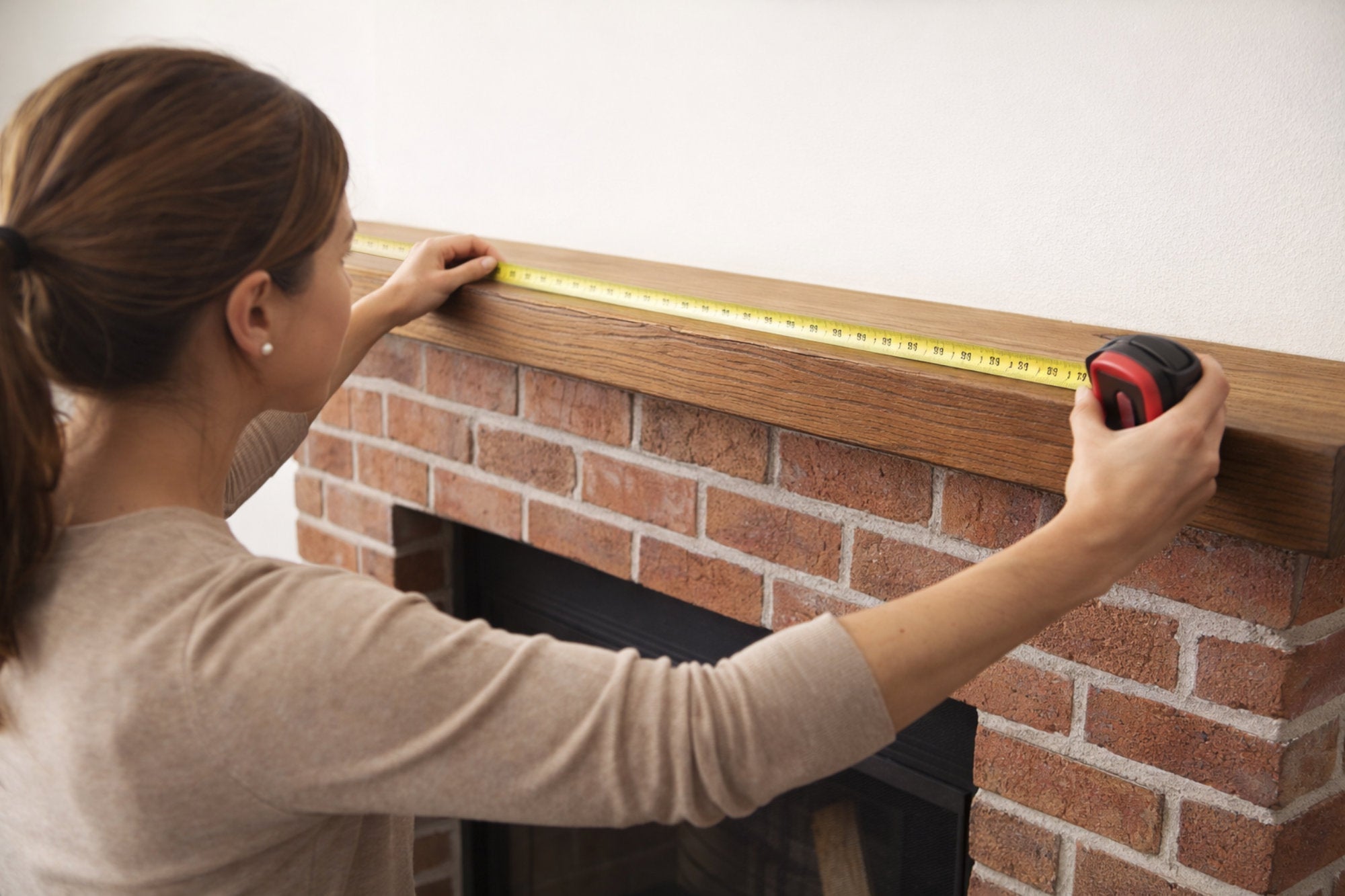
Measuring your existing fireplace mantel for a cover can feel intimidating—especially if you’re worried about getting something wrong. The good news is that it’s actually very straightforward, and you don’t need special tools or construction experience to do it correctly.
This guide walks you through the exact measurements we need to create a custom mantel cover that fits cleanly and looks great in your space.
What You’ll Need
-
A tape measure
-
A notepad or your phone to record measurements
-
A clear view of the existing mantel
Optional but helpful:
-
A few photos of the mantel from the front and sides
The Three Measurements That Matter
When measuring for a mantel cover, the three most important dimensions are: length, height, and depth. Accuracy matters more than speed, so take your time and double-check each measurement.
1. Measure the Length
Measure the mantel from end to end, following the longest horizontal distance.
-
If your mantel runs wall to wall, measure the full width between the walls.
-
If it floats with exposed ends, measure from one end of the mantel to the other.
- If the mantel has uneven ends, measure the widest point.
Write this number down as your length. (A).
2. Measure the Height
Measure the vertical height of the existing mantel from the bottom edge to the top surface.
-
Do not include decorative trim or molding above or below unless it is physically part of the mantel.
-
If the mantel has uneven edges or wear, measure the tallest point.
Write this number down as your height. (B).
3. Measure the Depth
Measure from the front edge of the mantel back toward the wall.
If the mantel depth varies slightly, note the deepest measurement.
Write this number down as your depth. (C).

If Your Mantel Sits on a Surround
In many homes, the mantel does not float on its own, it rests on a brick, stone, or wood surround below it. If that’s the case, we need two additional measurements so the cover fits cleanly.
Measure the Surround Length
Measure the surround from end to end, following the widest horizontal point directly beneath the mantel.
Record this as the surround length. (E)
Measure the Surround Depth
Measure how far the surround projects out from the wall.
-
Measure at the deepest point
-
Brick and stone surrounds often vary slightly—note the largest depth
Record this as the surround depth. (D)
These measurements allow us to account for how the mantel cover interacts with what’s underneath and create a cutout so the cover will slip on perfectly.
If Your Mantel Isn’t a Simple Rectangle
Some mantels have details that don’t fit a basic rectangular shape, including:
-
Tiered or stepped mantels (one, two, or three levels)
-
Decorative profiles that angle inward
-
Uneven brick or stone
If this describes your mantel, start by measuring the largest overall length, height, and depth using the steps above.
After that, photos are the most helpful next step.
A few clear pictures from the front and sides allow us to:
-
See stepped or angled details
-
Identify which surfaces matter for fit
-
Request additional measurements if needed.
You don’t need to solve the geometry—we’ll take it from there.
Common Measuring Mistakes to Avoid
A few small errors can cause confusion later. Here are the most common ones we see:
-
Measuring surrounding trim instead of the mantel itself
-
Assuming mantels come in “standard sizes” (they don’t)
-
Forgetting that walls and brick are often slightly uneven
-
Rounding measurements too aggressively
When in doubt, measure twice and record the most accurate number.
What Happens After You Measure
Once you have your measurements, we use them to design a mantel cover that fits over your existing mantel with proper allowances for wood movement, wall variation, and installation.
Photos are always welcome and often help us confirm details like:
-
Uneven brick or stone
-
Wall-to-wall conditions
-
Trim or adjacent materials
If something looks unusual, we’ll flag it before anything is built.
You can view our full collection of custom fireplace mantel covers here.
Why We Recommend Ordering Samples First
Even with perfect measurements, color and finish are often the hardest decisions to make online.
Wood tones can look very different depending on:
-
Natural vs artificial light
-
Wall color and flooring
-
Surrounding materials like stone or tile
Ordering wood and stain samples allows you to see the material in your own home before committing. Many customers find that samples give them confidence not just in color, but in the overall direction of the project.
Order wood & stain samples
If you’re still researching whether a mantel cover is right for your fireplace, our complete guide walks through measuring, installation, and what to expect with brick, stone, and uneven surfaces.
complete guide to fireplace mantel covers
Final Thoughts
Measuring your mantel doesn’t require guesswork or special expertise, just a careful approach and clear numbers. Once you have those, the rest of the process becomes much simpler.
If you ever have questions or want a second set of eyes on your measurements, we’re always happy to help.
Measuring FAQs
Do I measure the trim or the mantel itself?
Measure the mantel itself, not decorative trim or molding that may sit above or below it. If you’re unsure whether something is part of the mantel or just decorative, photos can help us confirm.
What if my mantel isn’t perfectly square or has decorative details?
That’s very common. Start by measuring the largest overall length, height, and depth using the steps above. If your mantel is tiered, angled, or uneven, clear photos from the front and sides are the best next step—we’ll use those to account for the details during design.
Can you help confirm my measurements before ordering?
Yes. You’re welcome to send us your measurements along with a few photos of the mantel. We’re happy to review everything and flag anything that might need adjustment before moving forward.
Share:
How High Should You Hang a Fireplace Mantel? Here’s the Honest Answer.
Are Mantel Covers Secure? How They’re Installed and Supported